















Где искать: по сайтам Запорожской области, статьи, видео ролики
пример: покупка автомобиля в Запорожье
Argentina: 85-million-year-old fossil eggs found on Neuquen university campus
 У вашего броузера проблема в совместимости с HTML5
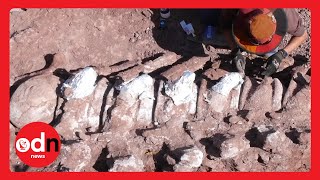
More than a hundred egg fossils from a prehistoric bird species that lived in the area some 85 million years ago have been found in the Argentine city of Neuquen, 1,163 kilometres (772 miles) southwest
of Buenos Aires.
A team of palaeontologists from the university could be seen working at the site of the find, and in a laboratory with some of the eggs and other fossils, on Wednesday.
“Fossil remains dating back some 85 million years to the Upper Cretaceous period were found, of bird eggs of a particular group of birds called ‘Enantiornithes,’” said Juan Porfiri, coordinator of the National Science Museum at the National University of Comahue.
According to local reports, the discovery was made during a series of works prior to the construction of a building at the National University of Comahue.
According to Porfiri, the eggs correspond to birds that “lived during the Mesozoic era, they were very small birds a little bigger than a pigeon.”
Neuquen, and its eponymous province of which it is the capital, in Argentina’s Patagonia, is an area rich in paleontological finds.
—-
SOT, Juan Porfiri, Coordinator of National Museum of Sciences at National University of Comahue (Spanish): “Fossil remains of 85 million years old from the Upper Cretaceous period were found, of eggs, precisely of birds, of a particular group of birds called ‘Enantiornithes’ and they were found here in the grounds of the National University of Comahue, precisely what is part of the campus.”
SOT, Juan Porfiri, Coordinator of National Museum of Sciences at National University of Comahue (Spanish): “They lived during the Mesozoic era, they were very small birds a little bigger than a pigeon. They laid these eggs that were about 5cm (1.9 inches) long in the polar part, let’s say. And on the equatorial circumference of these eggs about 2.5cm (0.9 inches).”
SOT, Juan Porfiri, Coordinator of National Museum of Sciences at National University of Comahue (Spanish): “Some are basically eroded, others are in a much more complete state and at the same time many nesting sites have been found, they are nesting sites, it is a paleontological site where we have at least 140 nesting sites. In some of these sites in particular there are clutches with 3 or 4 eggs, in other words, we are talking about around 150, 160 at least, because in some there are isolated eggs and in others, there are more than one.”
SOT, Macarena Martinez, Geology student (Spanish): “What we do at the moment, the four advanced geology students, is come to the field, we monitor, we are present when the machine is working, as it digs because it is clearly an area with fossils. So we have to be there all the time controlling the sediment that is being removed.”
#Argentina #FossilEggs
Video ID: 20210722-041
Video on Demand: https://ruptly.tv/videos/20210722-041
Contact: [email protected]
Twitter: http://twitter.com/Ruptly
Facebook: http://www.facebook.com/Ruptly