
















Где искать: по сайтам Запорожской области, статьи, видео ролики
пример: покупка автомобиля в Запорожье
Israel: 1.5 million-year-old human remains discovered near Jordan Valley, lead researcher confirms
 У вашего броузера проблема в совместимости с HTML5
Follow us on Telegram:
https://t.me/s/ruptlynews
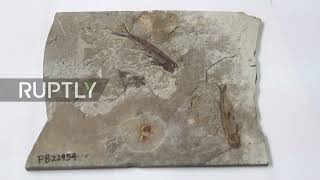
A group of researchers from various universities discovered the remains of a human vertebra dated to be 1.5 million years old near the Kibbutz Beit Zera in the Jordan Valley and confirmed the findings on Wednesday.
Alon Barash, the lead researcher of the group, commented on the discovery from the Bar-Ilan University in Safed, Israel.
“We know that the earliest stages of human evolution took place in Africa, based on the fossil record in and by comparing DNA data from apes and humans. However, over the years, there is a continuous debate about the nature of out of Africa migration,” Barash said.
According to the research paper published, the findings indicate that ancient human migration occurred over several waves as opposed to being a one-time event.
—-
SOT, Alon Barash, Lead Researcher: “The site of ‘Ubeidiya is found close to the southern edge of the Sea of Galilee, near Kibbutz Beit Zera, and is one of the earliest prehistoric site to be found outside of Africa. It dates to around 1.5 million years ago, the only other site that predates ‘Ubeidiya is Dmanisi in the Republic of Georgia, which dates to around 1.8 million years ago. Over there was discovered and excavated in the early 60s by many of the famous Israel Pre-Historians who uncovered rich, stone tools assemblages that were used by early humans together with numerous animal bones, some of which went extinct long time ago, like saber-toothed cats and mammoths, but others that are not usually associated with Israel, such as hippos, rhinos and big crocodiles.”
SOT, Alon Barash, Lead Researcher: “In 2018, Miriam Belmaker won the National Science Foundation grant to study the ancient climate and to accurately date the site. While studying animal bones from the site, she came across a vertebra with human like feature that was actually excavated in 1966. Together with Professor Ella Been, we studied the vertebra and came up with some new and important conclusions. First, it is a fossilized early human bone that belonged to a child. We know so because of the shape of the vertebra, and the fact that it is incomplete, meaning that it did not finish its growing process. We estimated had it reached adulthood, this individual would be around 1.8 meters tall, and weigh about 90 kilograms. These numbers are similar to some of the large bodied hominins that are found in Africa in the similar time period, but they’re very different from the small body hominins that we found in Georgia.”
SOT, Alon Barash, Lead Researcher: “Second, he will witness two distinct human species at the same time period, which is known as the lower Pleistocene outside of Africa. We know that the earliest stages of human evolution took place in Africa, based on the fossil record in and by comparing DNA data from apes and humans. However, over the years, there is a continuous debate about the nature of out of Africa migration. Was this a one time event or did it take place in multiple occasions?”
SOT, Alon Barash, Lead Researcher: “Our core study indicates that early hominins migrated at least twice and in two distinct ways. This is because the people of Dmanisi are different in size and shape from those in Ubeidiya. Moreover, doctor Omry Barzilai, who studied the stone artifacts from both sides, concluded that the stone manufacturing techniques are, as well as the stone tools themselves, are different. Professor Miriam Belmaker concludes the climate as well as the animals are also different in both sites. Thus, with each migration wave came new and different types of hominins with their own stone making traditions, which may indicate maybe about their cognitive abilities and the different preferences of their ecological nation habitat.”
#Israel #JordanValley
Video ID: 20220202-033
Video on Demand: https://ruptly.tv/videos/20220202-033
Contact: [email protected]
Twitter: http://twitter.com/Ruptly
Facebook: http://www.facebook.com/Ruptly