















Где искать: по сайтам Запорожской области, статьи, видео ролики
пример: покупка автомобиля в Запорожье
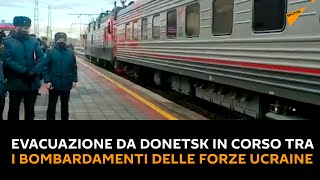
Russia: Donbass evacuees continue to arrive in Voronezh
 У вашего броузера проблема в совместимости с HTML5
Follow us on Telegram:
https://t.me/s/ruptlynews
Donbass refugees continued to arrive in Voronezh by train on Sunday. Earlier, the deputy head of the Voronezh city district for social policy, Nadezhda Savitskaya, said that two local camps in Voronezh, Blue Screen and Kirovets, resumed their work to accommodate 140 and 240 people.
According to Russian EMERCOM, around two thousand people were transported from Rostov to Voronezh Oblast per day.
Earlier, the head of the self-proclaimed Donetsk People’s Republic, Denis Pushilin, announced the evacuation of civilians to Russia to avoid their getting caught in the crossfire if fighting continues to break out.
Kiev and the self-proclaimed Donetsk and Lugansk People’s Republics have accused each other of ceasefire violations and shelling in recent days. The OSCE has confirmed numerous breaches of the ceasefire regime in recent days.
The USA and other Western countries have expressed fears that Russia could stage a ‘false-flag’ attack to justify invading Ukraine, amid reports that Moscow has concentrated around 150,000 troops next to Ukraine’s border.
Russia has said it is carrying out planned military drills and that some of the troops have been already withdrawn to their permanent bases, though Western countries have said there is no evidence of a pull-back.
On Thursday, US President Joe Biden said military action could begin “in the next several days” but stressed that a diplomatic solution was still possible.
Moscow has denied intending to invade, accusing the West of stoking tensions.
SOT, Marina Batrakova, Donetsk resident (Russian): “And there are two houses left [in Donetsk], cats left behind. Of course, we’re worried the houses remain preserved. We, of course, wish prosperity to our Donetsk.”
Journalist (Russian): “Were you scared there?” *VOICEOVER*
Marina Batrakova, Donetsk resident (Russian): “Of course. I have a war child. She [daughter] was born in the explosions, barrages. And to hear this word [war], of course, I don’t want her to.”
Journalist (Russian): “What did you take with you, probably the most necessary things?” *VOICEOVER *
Marina Batrakova, Donetsk resident (Russian): “Yes, I left everything, that’s the thing, I didn’t even have time to take my salary, nothing, nothing at all.”
Journalist (Russian): “And you hope to go back there [to Donetsk]?” *VOICEOVER *
Marina Batrakova, Donetsk resident (Russian): “Well, yes, we hope.”
Marina Batrakova’s daughter (Russian): “Even though I was born in the war, but I know what war is like.”
SOT, Lyudmila Baeva, Staromikhailovka village resident (Russian): “I went through the whole war, I lived there [in Donetsk oblast] under bombing, I know what it’s like, and that’s all. My husband just brought us here, to a safe place, for the children’s sake, he stayed and went to fight. Said to raise, I want to…”
SOT, Artem Verkhovtsev, Deputy Chairman of the Voronezh Region Government (Russian): “When determining places of temporary accommodation, we proceeded from the tasks set by the governor, so that these were places with, let’s say, normal, good conditions, i.e. bedding, hot meals, domestic support, washing, laundry, everything else. Today we will organize a hotline for arriving citizens, we will bring them information through the temporary accommodation centres, we will collect the problems that will arise, and we will solve the issues that they [refugees] will have as they arrive, as long as everything goes smoothly, we are ready. The services’ work together with the EMERCOM’s [Russian] main department is lined up.”
SOT, Anna Vdovichenko, Donetsk resident (Russian): “Leaving Donetsk was a little bit scary. We’ve been living in that environment for eight years; it’s to come. We’ve come [here], my husband stayed there [in Donetsk], he’s in the army, serving. We’ve come with a child, relatives.”
SOT, Elena Roi, Donetsk resident (Russian): “There were sirens in the morning, I didn’t even know. They called, said so, and so. Then an acquaintance called, [said] that we had to move out. Then my son-in-law called and said that we had to pack up and leave because it was going to be bad.”
Journalist (Russian): “You felt that maybe fear, terror, I don’t know, yes; still it is.” *VOICEOVER*
Elena Roi, Donetsk resident (Russian): “Yes, you know, it’s from 2014 [situation in Donetsk], very tired.”
#Donbass #Ukraine #Russia
Video ID: 20220220-033
Video on Demand: https://ruptly.tv/videos/20220220-033
Contact: [email protected]
Twitter: http://twitter.com/Ruptly
Facebook: http://www.facebook.com/Ruptly