

Sunday, 09 August, 2026г.
















Где искать: по сайтам Запорожской области, статьи, видео ролики
пример: покупка автомобиля в Запорожье
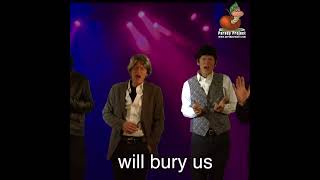
Should Old Offenses Be Forgot? - Tribute to E. Jean Carrol | Don Caron
 У вашего броузера проблема в совместимости с HTML5
This parody was created and posted in 2017 so you can see that while everything changes, everything also stays the same. But what did change is the perpetrator has finally been held to account. #defamation
Executive Producers Don Caron and Jerry Pender
SUPPORT
Visit https://parodyproject.com/supportus
CONTRIBUTE to the PROJECT
BTC: 33W8cvkCKupG77ChtTFXeAFmEBCaLcjsBJ
ETH: 0x1f36edE7A4F06830D0e3d675776607790a2ce636
SHOP
Parody Project Store: https://parodyproject.com/shop
PATRONAGE
To become a Patron of Parody Project please visit our Patreon Page
https://www.patreon.com/parodyproject
MAILING LIST (Never Shared)
https://parodyproject.com/subscribe/
Lyrics by Don Caron / Music - Scottish Folk Song
Should old offenses be forgot?
And never brought to mind?
For those who hope to not get caught,
to forget’s a thing sublime!
It’s in their nature don’t ye know,
in their genetic code;
No wonder why the handsome prince
is depicted as a toad.
But leaders have a higher call
including self-restraint
It’s not like we lookin' to
Just treat us all with decency
and remember to be sure,
she never once invited you
to play with her coiffure.
So raise your glass to dinosaurs
who n’er learned to behave
Their brains are always on all fours
and will be so to the grave.
Their days are past their time is done
we watch them as they go
in shame departing one by one
yet the worst refuse to go.
How can we teach our daughters and sons
to act with grace and love,
with poor example from the top
we cannot soon get rid of?
Should offenses be forgot
and never brought to mind?
should that be so, the lesson taught,
bodes ill for womankind.
Should that be so, the lesson taught,
bodes ill for all mankind.
HISTORY OF THE SOURCE MATERIAL
Auld Lang Syne" is a Scots poem written by Robert Burns in 1788 and set to the tune of a traditional folk song. It is well known in many countries, especially in the English-speaking world, its traditional use being to bid farewell to the old year at the stroke of midnight. By extension, it is also sung at funerals, graduations, and as a farewell or ending to other occasions. The international Scouting movement, in many countries, uses it to close jamborees and other functions.
The song's Scots title may be translated into standard English as "old long since", or more idiomatically, "long long ago," "days gone by" or "old times." Consequently, "For auld lang syne," as it appears in the first line of the chorus, might be loosely translated as "for (the sake of) old times."
Robert Burns sent a copy of the original song (Auld Lang Syne) to the Scots Musical Museum with the remark, "The following song, an old song, of the olden times, and which has never been in print, nor even in manuscript until I took it down from an old man." Some of the lyrics were indeed "collected" rather than composed by the poet; the ballad "Old Long Syne" printed in 1711 by James Watson shows considerable similarity in the first verse and the chorus to Burns' later poem, and is almost certainly derived from the same "old song."
VERSE:
Should Old Acquaintance be forgot,
and never thought upon;
The flames of Love extinguished,
and fully past and gone:
Is thy sweet Heart now grown so cold,
that loving Breast of thine;
That thou canst never once reflect
On old long syne.
CHORUS:
On old long syne my Jo,
On old long syne,
That thou canst never once reflect,
On old long syne.
There is some doubt as to whether the melody used today is the same one Burns originally intended, but it is widely used in Scotland and in the rest of the world.
Singing the song on Hogmanay or New Year's Eve very quickly became a Scots custom that soon spread to other parts of the British Isles. As Scots (not to mention English, Welsh and Irish people) emigrated around the world, they took the song with them.
A manuscript of "Auld Lang Syne" is held in the permanent collection of The Lilly Library at Indiana University in Bloomington, Indiana.
The phrase "Auld Lang Syne" is also used in poems by Robert Ayton (1570–1638), Allan Ramsay (1686–1757), and James Watson (1711) as well as older folk songs predating Burns. Matthew Fitt uses the phrase "In the days of auld lang syne" as the equivalent of "Once upon a time..." in his retelling of fairy tales in the Scots language.
Похожие видео



Мой аккаунт