

Monday, 10 August, 2026г.
















Где искать: по сайтам Запорожской области, статьи, видео ролики
пример: покупка автомобиля в Запорожье
Amazing Long-Term Survival Hut, Rammed-Earth Walls, Debris Roof
 У вашего броузера проблема в совместимости с HTML5
Support me on Patreon for just $1 a month! https://www.patreon.com/aspiring_caveman
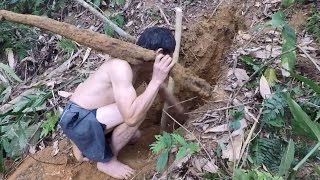
This is my shelter for the first half of the third year of my journey. I'm back at my old stomping grounds - my hometown - Miskolc, Hungary. It lies right on the edge of the Bukk Mountains National Park. It had been a long time since I spent the summer in Europe, so I was very excited to do this here. It is a very different environment from South New Jersey where I built my last shelter. It's a hardwood forest, where I knew I would have good debris to make use of, but unlike last year I had no idea what kind of place I was going to build beyond that.
Well, it turns out I got lucky in more ways than one (Tracker lucky, I like to call it). So much so that I’m happy to report that no live/uninjured trees were used to make this hut. A large European Beech (they named the park after them – Bukk = Beech) came down - the roots gave out for some reason – and took another, already dying tree with it. When I saw that, I knew right away that was place I was going to build my new shelter. As a matter of fact, no building material came farther than 400 yards. The only live vegetation came in the form of some ivy for cordage and half of the vine for the chimney shoot was also harvested live but in a caretaking manner. The sticks for the wickerwork came from underneath the power lines in the area that were cut by maintenance workers in the early spring. It came together very nicely.
In terms of tools, I stuck to my pervious goal: my Tom Brown Tracker T1 knife and whatever primitive tools I could make beyond that on the first pass for every part of the building process. Once I proved that it could be done, I would work in other simple hand tools. On this occasion, it ended up being very simple. The only other thing I used here-and-there was a folding saw.
The primitive tools I made were a rake, a “shovel-grade” digging stick, a hoe, a travois and a double survival vice. The only thing I didn’t make but I should have was a basket to haul dirt.
Acknowledgement: As I said earlier, I owe a great deal of thanks to Dave the Australian "primitive technology" guy. I also need to mention Tom Brown, Jr., the founder of the Tracker School. I have taken a ton of classes at his school, and none of this would be possible without what I got there. Cavemen and primitive technology people of the world, unite!
Kaveman Kwiz
I read the comments regularly and try to answer as many as I can. However, there is a reason why this and all the other videos on this channel are non-talking. I am convinced that the best way to learn is by watching what's being done and then trying to figure out how it is done by asking ourselves questions. Here are some examples to send you on your journey to learn like a caveman.
1. What may be the advantages of using a rammed-earth wall in a shelter instead, say, wood?
2. The hut is built on a mound, but it's sunk about a foot (30 cm) in the ground. What could be the purpose behind that?
3. At 2:42, I am putting the ends of my posts in a fire. What is the purpose of that?
4. One of the tools I made was a hoe with a wooden blade (5:45). What else could have primitive peoples used instead of wood?
5. If I were to create both the "deluxe" digging stick and the hoe, I may char their "business end" first than hone the edges. Whey would that be a good idea?
If you think you know the answer, put them in the comments. The idea here is to start a community converstion on these topics.
Теги:
long-terms survival primitive living primitive hut outdoor living homesteading primitive technology survival skills self-realiance natural building
Похожие видео


Мой аккаунт