
Thursday, 04 June, 2026г.





Где искать: по сайтам Запорожской области, статьи, видео ролики
пример: покупка автомобиля в Запорожье
Barcelona City Parks and Green Spaces
 У вашего броузера проблема в совместимости с HTML5
Free video about Barcelona City Parks. This video was created for you by http://epsos.de and can be re-used for free under the creative commons license with the attribution of epSos.de as the original author of this Barcelona City Parks video.
Thank you for supporting the creative commons movement !!
In Barcelona you have the chance, walking the streets, to find traces of its long history, from the Roman ruins and the medieval city up to the neighborhoods of Catalan modernism, with its characteristic buildings, its square blocks, its tree-lined streets and its wide streets. Barcelona is the city where he lived and worked the architect Antonio Gaudi, whose works attract many tourists every year from all over the world.
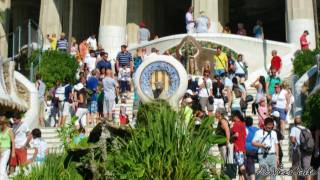
Barcelona has many parks. The best known are the Parc Güell by Antoni Gaudí in the district of Gracia, the park of Montjuich, located on top of the mountain of the same name and the Parque de la Ciudadela (Ciutadella), located in the city center and within which is the Parliament of Catalonia and the zoological park of the town famous for hosting the albino gorilla Snowflake. Recently opened the Park of Diagonal Mar, the largest in the city, designed by Enric Miralles. Other smaller parks are: the "Park of the Industrial Spain" in the district of Sants, the Parc de l'Estació North by Beverly Pepper, the "Children's Forum" where he played the Universal Forum of Cultures of 2004, the Park the labyrinth of Horta, park where the trees are planted to form a labyrinth, the "Parco del Clot" near the Plaza de las Glories and the "Turo Park", near the Plaça de Francesc Macia.
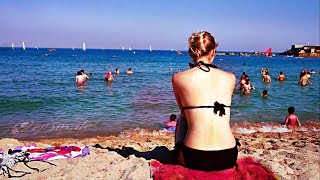
One of the main attractions of Barcelona in recent years have been its beaches. Thanks to the regeneration of the waterfront implemented in 1992, for the Olympics, Barcelona can now count on six beaches that stretch for more than 4.2 kilometers. The beaches are central: connected to the historic center and all a few minutes from the city. All the beaches are equipped with the most important services: showers, security, first aid and, in some cases, changing-room and rental service of hammocks, sun loungers and umbrellas. The beaches are subjected to cleaning every day throughout the year and have all the blue flag of the European Union. According to data of the city of Barcelona, every year the beaches of Barcelona receive more than seven million bathers.
Barcelona was during many centuries the center of cultural diffusion. For example, it was the first center of production of cartoons comic of Spain, ahead of Valencia and Madrid. Currently the cultural manifestations are very abundant, and many were held in the open thanks to the fact of being in a Mediterranean town.
In addition to being an extraordinary city from the point of view of tourism and entertainment, Barcelona has always had a leading role in the cultural sphere. Barcelona is the setting for important festivals in the world of music among which the Primavera Sound Festival of pop-rock, which takes place in thirteen days in the month of May, the Sónar festival, which in July brings together the best in the world of electronic music.
The high population density of Barcelona, as in any other European city, the traffic makes it particularly clogged, despite the excellent urban organization that promotes good flow of traffic. Since May 2005, the municipality has opened the green areas of parking and has expanded the blue for a fee in the most central districts. Many people use motorcycles; Barcelona is the European city with the highest density of motion in relation to the number of inhabitants.
The series of parks and gardens Barcelona has an area of 2784 hectares. It's management depends on the Municipal Institute of Parks and Gardens of Barcelona, a body depending on the City Council. Since the nineteenth century and especially in the twentieth Barcelona has opted for the adaptation of green areas in the city, and is currently one of the European cities with more street trees.
The gardening in Barcelona has been evolving in different time: the first performance of some significance, the Labyrinth Park Horta is now the eighteenth century; the nineteenth century opened the first public park in Barcelona.
Depending on its features, parks and gardens Barcelona are divided into different types, "historic", those created before 1950, such as the Labyrinth Park Horta on the Citadel, the Güell Park, Gardens the University of Barcelona, in the Laribal and the Royal Palace of Pedralbes; "Themes" which are dedicated to a particular type of plant species, such as the Parc de Cervantes.
Thank you for supporting the creative commons movement !!
Теги:
best free creative commons beautiful most amazing cool awesome great interesting nice barcelona city travel streets people BCN EUrope summer vacation Sweet Fun Good european destination Adventure Pretty Culture street place famous architecture historic scenic cityscape catalunya spain spanish old town central tour Barca Barça buildings beauty catalan Europa tourism
Похожие видео
Мой аккаунт