

Saturday, 19 September, 2026г.















Где искать: по сайтам Запорожской области, статьи, видео ролики
пример: покупка автомобиля в Запорожье
Celebration of 60 years of Treaties of Rome, DigitalDay, DANCE EU Project Performance/Showcase
 У вашего броузера проблема в совместимости с HTML5
"Europa: Gestures of History
Dancing Science and Art not to forget EU identity"
Digital Day, Celebration of the 60 Years of the Roma
Treaties of Rome
La Lanterna, Rome, 23 March 2017
Giulia Mureddu, dance
Virgilio Sieni and Giulia Mureddu, choreography
Andrea Cera, sonic design
Stefano Piana, software for real-time analysis of movement qualities
A project of Casa Paganini-InfoMus Research Centre, DIBRIS-University of Genoa, coordinated by Antonio Camurri
This project has received funding from the European Union’s Horizon 2020 research and innovation programme under grant agreement No 645553
Presentation
Close our eyes to see more, open our ears to actively re-think to our history.
i. The Project
Traditionally, we dance on a given music. Is it possible a dance produces its own music? The EU ICT Project DANCE is designing multimodal sensible technologies able to automatically recognize the emotional qualities of a movement and to transform them in perceptually coherent sequence of sounds. The scientific and technological challenge of DANCE consists in demonstrating how (and how much) the affective and relational quality of gestures can be perceived through different and interactive sensory configurations: not only by viewing their trajectories in space but also hearing the sounds they generate in real time by means of a psychophysically and perceptually coherent “translation”. In our hyper-connected society, where our senses are overwhelmed by high-speed internet, mobiles, the risk is to loose content communication, even with the raise of pathologies. DANCE investigates ICT solutions to these problems: can deprivation of one sensory channel (e.g. vision) enhance a deeper communication and understanding of socio-affective content with another channel (e.g. auditory)? Can blind persons appreciate a dance, and in general qualities of body movement, by means their auditory channel?
ii. The Concept
According to Ovid, the foundational myth of Europa, the fair Phoenician princess, whose name gives the name to our community, can be told as a succession of four basic gestures: the afraid but intrigued walking of Europa toward Zeus/bull; her abandonment on his strong and powerful body; her last look, back to the land she is leaving for ever; her free flight in the sky to reach her destiny. Each of these gestures expresses clearly an affective quality of movement: hesitation, heaviness, fragility, lightness. Each of these gestures represents in figure an emotional moment of the common European identity building history: the uncertainty of the beginning, the weight of its concrete realization, the afraid temptation of backing off, the perpetual rising of the dream.
iii. The DANCE-trailer
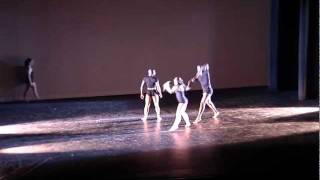
The dancer deeply explores and shows with her body movements the qualities of the four Europa gestures, dialoguing with four wall-projected pictorial representations of the same qualities identified in the Rape of Europe (from the great Italian artistic history), and automatically generating with her dance itself a coherent sound resonance.
Europa: Gestures of History aims to shortly but deeply exhibit the strong impact on society of evoking cultural, historical and social contents, through the experience enabled by new interactive and multimodal DANCE technologies, sensible to the affective expressiveness of a moving body, its non-verbal but affectively communicative emotional language.
Теги:
Music and emotion EyesWeb multimedia computer DANCE H2020 EU ICT Project interactive dance expressive movement qualities interactive sonification
Похожие видео
Мой аккаунт