

Tuesday, 25 August, 2026г.







Где искать: по сайтам Запорожской области, статьи, видео ролики
пример: покупка автомобиля в Запорожье
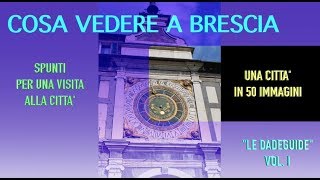
Cosa vedere a Brescia? Visita alla città della Lombardia - Italia
 У вашего броузера проблема в совместимости с HTML5
The origins of Brescia date back to 1200 BC, when a population, probably from Liguria, built a settlement near Colle Cidneo. In the seventh century BC the Cenomani Gauls settled here, making Brescia their capital. Subsequently, at the turn of the 3rd and 2nd centuries BC, as a result of clashes between Insubri, Galli and Romans, Brixia began the process of annexation to the Roman Republic, which culminated in 41 BC. when the inhabitants obtained Roman citizenship, while maintaining a certain administrative autonomy.
From 402 to 493 it underwent numerous barbarian invasions, among which those of the Visigoths of Alaric, the Huns of Attila, the Heruli of Odoacre and the Ostrogoths of Theodoric; just below the latter the city acquired a key importance in the Ostrogoth kingdom. From 568 it became an important duchy of the Lombard kingdom.
Proclaimed an autonomous municipality as early as the twelfth century, it came under the Visconti domination and then, with the dedication of November 24, 1426, gave itself to the Domini di Terraferma of the Republic of Venice and will remain linked until the end of 1797.
In February 1512, during the War of the League of Cambrai, the French troops commanded by Pierre Terrail de Bayard and Gaston de Foix-Nemours conquered and plundered the city: this dramatic event led to the draconian decision by the Venetian authorities to demolish any building within a kilometer and a half from the city walls, so as to be able to more effectively protect the city from any other besiegers.
Annexed to the Kingdom of Lombardy-Veneto, during the Risorgimento it was the scene of the ten days of Brescia, and then to the annexation to the Kingdom of Italy in 1860.
On October 2, 1915, at the Campo di Marte (or Piazza D'Armi), the 3rd Fighter Squadron arrives, which on April 15th 1916 becomes 72th Fighter Squadron, which remains there until February 1917.
In 1932, through the demolition of the Pescherie district, on behalf of Benito Mussolini, Piazza della Vittoria was built in fascist style by the architect Marcello Piacentini, who built the first skyscraper in Italy, the Torrione, which is among the very first skyscrapers in Europe.
On July 13, 1944, the city center was bombed by Anglo-Americans who dropped 124 tons of explosives, killing more than three hundred people.
During the Second World War, with the creation of the Italian social republic, informally called of Salò, Brescia became the seat of some ministries.
On May 28, 1974, the attack took place in Piazza Loggia, while a demonstration against neo-fascist terrorism was called by the unions, causing the death of eight people and injuring more than a hundred others.
Теги:
appartamenti affitto Pavia vendite Italy Lombardia case locazioni affitti locazione acquisto appartamento casa immobile immobili allegrone immobiliare agenzia brescia lombardia giro della città Lombardy
Похожие видео
Мой аккаунт