

Saturday, 08 August, 2026г.
















Где искать: по сайтам Запорожской области, статьи, видео ролики
пример: покупка автомобиля в Запорожье
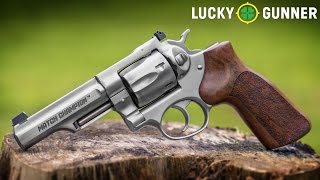
Dec 2014: Ruger GP100 Match Champion 357 Magnum Revolver Review
 У вашего броузера проблема в совместимости с HTML5
Ruger GP100 Match Champion No. 1754 357 Magnum, $899
The Ruger GP100-series revolvers are different from the Smith & Wesson 686s, but both guns were introduced to provide more durability than previous models.
The Ruger GP100 replaced the Security Six revolver in about 1986 with innovations such as stronger lockup built into the cylinder crane rather than at the tip of the ejector rod. Another feature that adds strength to the GP100 design is the lack of side plates in the construction of the frame.
Plus, additional steel was added to critical areas that support the barrel.
Referred to as medium sized (between the 5-shot SP101 and Redhawk double-action revolvers), the grip frame, or butt, of the GP100 was peg-like, making it possible to apply different sized grips, including very small ones to aid concealment.
However, being a target and competition model, the priority for this revolver was shooter comfort. The Match Champion’s Hogue Monogrip was a beautiful hardwood featuring graceful swells and stippled panels on each side. The GP100 Match Champion’s satin-stainless-steel surface was brighter than the Smith & Wesson finish of the same name. The Ruger Match Champion is the only GP100 that offers a partial underlug.
Two very recognizable Ruger characteristics were the polished flat-sided hammer and the “push-button” cylinder release. The cylinder release was hinged vertically at its center, so the operator actually must press inward on the rearmost half of the button. Otherwise, we found this design required little or no dexterity to operate.
The sights were a clear departure from those typically found on a revolver, whether fixed or adjustable.
Dovetailed and low-mounted, these Novak sights are more often seen mounted on sophisticated carry pistols than on revolvers. The front sight was also dovetailed into the top strap, and we found its visibility to be extraordinary, thanks to a bright-green fiber optic that gathered light from both its front and rear edges as well as from two reliefs cut into the top of the blade.
The rear unit was drift adjustable for windage. Changes in elevation could be effected by installing a different-height front-sight blade, but Ruger seems to have struck an effective balance with the supplied front blade.
We liked the thin Ruger trigger with smoothly rounded edges. Tucking it just inside the first joint of the index finger, the shooter could feel the trigger’s slight forward taper move directly to lockup, followed by a smooth, short press to release the hammer. Maximum resistance for the double-action press was 10.5 pounds. The single-action trigger weighed in at 4.0 pounds.
Accuracy results were very close to the Smith & Wesson’s. The Black Hills 148-grain lead wadcutters were best, measuring an average group of 2.3 inches. The Remington 38 Special +P ammunition printed 2.4-inch groups on average. The 357 Magnum rounds expanded to 2.7 inches per five shots, putting the Ruger behind the Smith by only a computed 0.03 inches for all shots fired.
In deciding between these handguns, we would like to make it clear that we’re going to call the rankings based purely on the guns as delivered, without consideration for the potential of each gun after spending time in the hands of a match-grade gunsmith.
The Ruger trigger was very smooth and acceptably light right out of the box — even for a competitive shooter. All it needs is chamfered cylinders to help it speed-load faster.
Теги:
.357 Magnum Revolver (Invention) Ruger GP100 Sturm Ruger & Co. (Business Operation) Shooting Sport (Sport) Revolver (Magazine)
Похожие видео

Мой аккаунт