
Tuesday, 11 August, 2026г.







Где искать: по сайтам Запорожской области, статьи, видео ролики
пример: покупка автомобиля в Запорожье
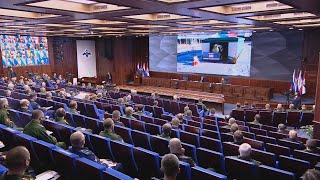
Д.Медведев.Коллегия Министерства обороны.05.03.10.Part 1
 У вашего броузера проблема в совместимости с HTML5
Speech at Expanded Meeting of the Defence Ministry Board.Part 1 March 5, 2010 Moscow Выступление на расширенном заседании коллегии Министерства обороны. 5 марта 2010 года Москва PRESIDENT OF RUSSIA DMITRY MEDVEDEV: Comrades, as the Defence Minister said just now, we are here to sum up the results of the Ministrys work over the last year and discuss our plans. I want to say a few words on some general issues. A month ago, I approved the Russian Federations new military doctrine, which is now being studied closely both here and abroad. I also approved the Principles of State Nuclear Deterrence Policy until 2020. On the basis of these two documents we can draw several important conclusions. First, we have no need today to continue increasing our nuclear deterrence capabilities, yet the possession of nuclear weapons remains a determining factor in Russias ability to pursue an independent policy directed at protecting its sovereignty, maintaining peace, preventing military conflict, and also helping to settle post-conflict situations. Last year, we adopted amendments to the Law on Defence. These amendments provide the legal grounds for the Russian Federation to use its Armed Forces to protect its citizens beyond our borders. We should remember too that there are conflict potential and unsettled problems close to our borders. This unquestionably creates a potential threat to our national security. But we are continuing our active efforts to cement the positive trends in international politics today. Over a relatively short time our intensive talks with the United States of America have brought us close to a new strategic offensive arms treaty, which will see both sides make cuts to their stockpiles of these weapons. After going through a somewhat rough patch, full-scale contacts between Russia and NATO have also resumed. The reaction to Russias European Security Treaty initiative serves in many ways as a barometer of our relations with the USA and NATO. The defining issue here is our partners willingness to give a legally binding form to the principle of indivisible security in Europe. Active discussion is underway on this document. It is my conviction that the treaty we propose would give us precisely the instrument we need to be able to prevent various regional conflicts, above all on the European continent, including conflicts similar to the Georgian-Ossetian conflict. Unfortunately, far from all countries and politicians have learned the lessons from what happened in August 2008. Unfortunately, Georgia continues to build up its military potential with the military support from outside. Taking this into account, and also the complicated social and economic situation in the Caucasus, I decided to establish the North Caucasus Federal District. Among other things, this makes its possible to coordinate the military and security forces there more effectively. Colleagues, the main aim of our efforts to modernise the Armed Forces is to create modern forces equipped with the latest arms. In September 2008 I approved the respective modernisation programme. Last year we put the organisational foundations into place, keeping to the tight deadlines that we set and without going over our planned spending. Our Armed Forces now comprise one million servicemen. Overall, the Defence Ministry has reached its objectives of establishing combat-ready Armed Forces, as was confirmed by the Autumn-2009 military exercises. As you know, I was present during the active stage of these exercises and saw the evidence that overall preparedness, coordination between the newly reorganised units and operations planning was all of rather high level. This does not mean that we have solved all our problems, but the overall impression was positive, especially when you think that it had been a very long time since we held military exercises of that level. These kinds of exercises need to become part of regular practice. Our Armed Forces simply cannot exist without them. Officer training remains an essential task to work on. The Armed Forces need top-class specialists familiar with modern technology and deeply motivated by the military profession they have chosen. We need to develop our military education system, improve its material base, which has deteriorated over the last years, and support teachers who are experienced and devoted to their work. Sergeants need to be a particular focus for our attention. Sergeants need to have the training to enable them to step in and replace officers at the primary level if the circumstances call for it. http://www.kremlin.ru
Теги:
Дмитрий Медведев Dmitry Medvedev Kremlin Moscow President Russia Президент России Speech Expanded Meeting Defence Ministry Board Выступление расширенном заседании коллегии Министерства обороны Москва
Похожие видео
Мой аккаунт