

Monday, 17 August, 2026г.
















Где искать: по сайтам Запорожской области, статьи, видео ролики
пример: покупка автомобиля в Запорожье
Driving Motorhome In Snow Storm - Unplowed Road In Mountains
 У вашего броузера проблема в совместимости с HTML5
.
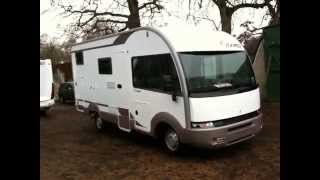
On Oct 28, 2013, we drove our motorhome into Yosemite on an unplowed highway. Our RV is a Lazy Daze class C motorhome and is 26' long. We drove into Yosemite by way of Highway 41.
That day's easy trip should have lasted about 4 hours, but with the snow it lasted over 7 hours. Putting on chains and driving at 25 mph or less doesn't get you anywhere very quickly. But slow and cautious is the way to arrive safely.
The snowfall gets a bit heavier about 3 minutes into the video (we're just outside of Fish Camp, CA at that point).
We only encountered 2 cars, a ranger and a large truck as we drove into the park. The 2 cars are crawling along slowly and I think they didn't have chains. The large truck is driving fast. I never drove faster than 25 mph, even though it might look faster in the video.
The valley floor had very little snow as it's only 4,000 feet. Road was clear and chains weren't necessary after we entered the park and we removed them at Wawona.
Sitting near the edge of the gas station at Wawona, a snowplow came up behind us and shoved a large amount of snow onto the side of the motorhome. If I had my window open, I would have been buried in snow. It was kinda funny, but startling.
One "possible" way to avoid snow going into Yosemite is to try highway 140 from Merced. This road enters Yosemite from lower elevations. It was snow free while I was traveling a snowy highway 41. You can cross over from highway 41 to 140 at Oakhurst, CA. On 10/28/13, there was no snow in the town of Oakhurst and crossing over to highway 140 would have been easy.
North of Oakhurst, the road hadn't been plowed in awhile, so we had new snow, plus some ice. But with my Z6 cable chains, I never had any problems controlling the motorhome. Steering, braking and traction were effortless and there was NEVER a loose or scary moment.
Now that I've driven our motorhome in snow and ice, I won't freak out on my next encounter, but chains, caution and slow driving are key elements for staying in control. A completely iced road is certainly going to be more challenging and would require slower speeds and more caution.
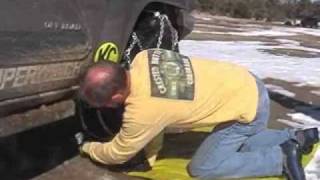
Putting on the cable chains can be a difficult chore with dual wheels. But I've solved that problem. I drive the inside rear wheel onto the Anderson Rapid Jack, which lifts the outside dual wheel off the ground. If you use a ramp to level your motorhome, you can use the ramp to lift your outside rear wheel.
With the outside rear wheel off the ground, it's VERY easy to put the Z6 cable chains on the rear wheels. It's unnecessary to put chains on the inside dual tires. The Z6 cable chains are a good choice when you have a NARROW inside clearance on your dual wheels.
I've put chains on with the dual tires setting on the ground.and it's NOT easy. It takes too long and too much effort, especially if its cold, wet and snowing (isn't it always like that when you're putting on chains). You want to give up and kick the crap out of the tires. It's the dual rear wheels that cause the problems. Single wheels on the ground can be managed quickly and easily with the Z6 cable chains. So if you don't have dual wheels, don't fret.
I have the Z6 video and the Rapid Jack on my channel showing you how to put on chains and lift the outside dual wheel off the road.
I have a Wave 6 catalytic heater and it's well suited for a 26' motorhome in cold weather. I highly recommend a catalytic heater instead of a forced air furnace. The Wave 6 uses no electricity and less propane.
I'm frequently "dry-camping" and conservation of water, propane and electricity are important to me.
Running low on electricity is always a problem. To avoid this, I have four 6 volt AGM house batteries (440 Ah total capacity), with a 1,000 watt inverter serving the rear living area of the motorhome (TV, DVD, misc equipment). All of my interior lights have been converted to LED. LEDs use a fraction of the electricity compared to incandescent or fluorescent lights.
With traditional lead acid batteries you can't discharge the battery below 50% without damaging the battery. AGM batteries can be discharged below 50% without damage. Lifeline AGM batteries are expensive, about $300 each. (UPDATE) After one of my Lifeline batteries failed I switched to Trojan AGM batteries and find they are definitely higher quality than the Lifeline batteries.
I have two 150 watt solar panels with a MPPT solar controller. I use a Xantrex Link 10 battery monitor to show (1) how much electricity I'm using, (2) how many amps I'm generating from the solar panels and (3) how many amps are left in the batteries. The newer version of the Link 10 is called the Link Lite.
As long as I have sun, I'm OK. I use about 80 amps each night running special equipment (that's a LOT of amps and not normal). If I'm sitting under the trees and I go without sun for several days, I have to drive the motorhome for several hours, or run the generator.
Теги:
Snow Lazy Daze Z6 Chains Yosemite Winter Ice Storm motorhome class c motorhome chains driving class c slippery road icy road Camping Cold
Похожие видео

![HOW BAD Was It ? [ WINTER STORM ]](/images/mq/9/47/6t2q82jo9TStc9.jpg)
Мой аккаунт