

Thursday, 13 August, 2026г.
















Где искать: по сайтам Запорожской области, статьи, видео ролики
пример: покупка автомобиля в Запорожье
German MP44 (also known as the StG 44 or Sturmgewehr 44)
 У вашего броузера проблема в совместимости с HTML5
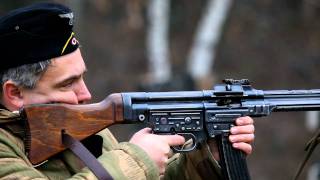
Todays review is of the German MP44. This classic firearm was an evolution of the World War II German firearms development program that developed an intermediate power cartridge in about 1938. This cartridge was the 7.92X33 mm Kurz, with the Kurz standing for "short". Development of a suitable weapon to fire the cartridge was initiated and the first field trials were done in 1942 with two different manufacturers fielding a version of the MKb (MaschinenKarabiner) 42. In 1943 the Haenel version was adopted and production began on the MP43 (MachinenPistole 43). There also was a slight variation designated as the MP43/1 that differed only in some minor muzzle details. In 1944 the designation was changed to MP44 with no changes made to the design. The designation was again changed to StG 44 in late 1944 for Sturmgeweher 44 or "assault rifle", hence being the first true assault rifle in existence. Construction is primarily of metal stampings and cast metal parts. The weapon is chambered for the Kurz round and fires from a 30-round double-stacked magazine. The weight is 11 pounds, length is 36.6 inches, and rate of fire is 500 to 800 rounds per minute. It is a select-fire weapon with the selector being a push-through button above the pistol grip. The safety is a lever on the left side operated by the thumb above and slightly to the rear of the trigger. The cocking handle is on the upper left side of the receiver and reciprocates with the bolt on firing. Some models have a scope mount on the right side that will accept the standard ZF4 scope and mount. The weapon was very innovative for the time and some people associate the weapon as a direct influence on the development of the AK47, which of course the Russians deny. It does have a unique sound signature when fired as you may notice during the firing demo. One issue with the weapon was the fact the hand guard was stamped steel with ventilation holes. When fired on full automatic and running through multiple magazines the hand guard heated up significantly. The usual option then was shifting the forward hand to grip the magazine well/magazine area instead of the hand guard. We will be firing the weapon using some 1958 & 1961 dated East German ammunition. The East Germans reissued some of these to border guards and police in the late 1950's and early 1960's and manufactured ammunition and some magazines to support that. The magazines were marked with a manufacturer code of 1001. Thanks for watching!
Похожие видео

Мой аккаунт