

Monday, 24 August, 2026г.
















Где искать: по сайтам Запорожской области, статьи, видео ролики
пример: покупка автомобиля в Запорожье
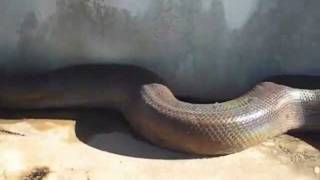
Giant Snake Eat a girl, You haven't seen this before !!!! Warning Kids don't play this video !!!
 У вашего броузера проблема в совместимости с HTML5
While initially thought to have been an apex predator of the Paleocene ecosystem in which it lived, evidence has pointed to the genus being dominantly piscivorous; a trait unique to Titanoboa among all boids.[4] The size of T. cerrejonensis has also provided clues as to the earth's climate during its existence; because snakes are ectothermic, the discovery implies that the tropics, the creature's habitat, must have been warmer than previously thought, averaging about 32 °C (90 °F).[1][2][5][6] The warmer climate of the Earth during the time of T. cerrejonensis allowed cold-blooded snakes to attain much larger sizes than modern snakes.
Today, larger ectothermic animals are found in the tropics, where it is hottest, and smaller ones are found farther from the equator.
However, other researchers disagree with the above climate estimate. For example, a 2009 study in the journal Nature applying the mathematical model used in the above study to an ancient lizard fossil from temperate Australia predicts that lizards currently living in tropical areas should be capable of reaching 10–14 m (32.8–45.9 ft), which is obviously not the case.[8] In another critique published in the same journal, Mark Denny, a specialist in biomechanics, noted that the snake was so large and was producing so much metabolic heat that the ambient temperature must have been four to six degrees cooler than the current estimate, or the snake would have overheated.
The first recorded sightings of giant anacondas were from the time of the discovery of South America, when early European explorers entered the dense jungles and claimed to have seen giant snakes measuring up to 18 metres (59.1 ft) long.[5] Natives also reported seeing anacondas upwards of 10.5 metres (34.4 ft)[5] to 18 metres (59.1 ft).[2] Anacondas above 5 metres (16.4 ft) in length are rare. The Wildlife Conservation Society has, since the early 20th century, offered a large cash reward for live delivery of any snake of 30 feet (9.1 m) or more in length, but the prize has never been claimed, despite the numerous sightings of giant anacondas. In a survey of 780 wild anacondas in Venezuela, the largest captured was 17 feet (5.2 m) long.[6] A specimen measured in 1944 exceeded this size when a petroleum expedition in Colombia claimed to have measured an anaconda which was 11.4 metres (37.4 ft) in length, but its claim has never been proven.[7]
Scientist Vincent Roth claimed to have shot and killed a 10.3 metres (33.8 ft) specimen, but like most other claims, it lacks sound evidence. Another claim of a large anaconda was made by British adventurer Percy Fawcett. Following his 1906 survey of the Bolivia/Brazil border, Fawcett wrote that he had shot an anaconda that measured some 19 metres (62.3 ft) from nose to tail.[8] Once published, Fawcett’s account was ridiculed. Decades later, Belgian cryptozoologist Bernard Heuvelmans came to Fawcett's defence, arguing that Fawcett's writing was generally honest and reliable.[9] Historian Mike Dash writes of claims of even larger anacondas, alleged to be as long as 45 metres (147.6 ft),[10] with some of the sightings supported with photos (although the photos lack scale). Dash noted if reports of a 18 metres (59.1 ft) anaconda strains credulity, then a 120 feet (36.6 m) long specimen would be an impossibility.
The Anaconda has been featured in many stories well known around Latin America, written by famous Uruguayan writer Horacio Quiroga, which even founded the Anaconda Association (a group of Argentine and Uruguayan intellectuals) circa 1920. He also published a book named Anaconda around 1921.
Perhaps the most well-known film portrayal of a giant anaconda in popular fiction is the 1997 film Anaconda, which featured a giant anaconda hunting and killing several crew members from National Geographic, and its sequel Anacondas: The Hunt for the Blood Orchid. Another two sequels and a crossover film, Anaconda 3: Offspring, Anacondas: Trail of Blood and Lake Placid vs. Anaconda were produced as made-for-television films in 2008, 2009 and 2015.
Теги:
Biggest snake funny video scary video video for fun video for danger black big snake big snake eating monkey big snake with man
Похожие видео


Мой аккаунт