
Sunday, 16 August, 2026г.














Где искать: по сайтам Запорожской области, статьи, видео ролики
пример: покупка автомобиля в Запорожье
Health Promotion Model by Nola Pender - Nurs 510 at Penn State University
 У вашего броузера проблема в совместимости с HTML5
Here is my video presentation on Pender's Health Promotion Model. Enjoy!
Slide 2: Nola Pender is a distinguished and influential nurse. In fact she is a Living Legend of the American Academy of Nursing Just a quick history on her- she received her diploma degree from a local hospital outside of Chicago. She then went on to receive her BS and MA from MSU and her PHD from Northwestern. She has taught at many universities most notably including Northern Illinois and Michigan where she mentored many future nurses.
Slide 3: While doing her doctoral degree she began to believe that there needed to be a switch in healthcare from caring for illness to disease prevention. This enabled her to believe that health promotion and disease prevention should be the primary focus in health care. She saw nurses as influencers and teachers promoting health habits and believed the definition of health is individual and not an all-encompassing term for everyone. This is considered a middle range theory.
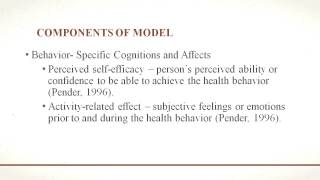
Slide 4: There are three main concepts that are included in this model are ( all displayed in the HPM diagram): Individual characteristics and prior experiences
Behavior-specific cognitions and affect, behavioral outcomes.
From these three main concepts the model can be further broken down
Personal factors can be psychosocial, biological, cultural. This can be gender, race, education, socioeconomic status. Secondly the first concept includes prior experiences from one person’s life and who influence them like family or their community.
Slide 5: For my nursing phenomena I decided to focus on nutrition. I feel this is important in a multitude of ways. If we can improve and teach healthy eating in the hospitals we can also improve outcomes during their stay like healing after surgery. In the hospital setting, this can mean undereating, overeating or lacking nutrition in what the patient is consuming and we are providing. The teaching could also influence them when they go home.
Slide 6: See stats on slide.
Slide 7: Comprehensive nutrition screening for all patients that would be done within 24 hours.
Education is key, in one study I found that discharge instructions are vital in the continuity of care. In the study it emphasized that nurses are the key component and that reevaluating dietary intake and access to healthy food options. Lastly another study found that we can reduce hospital stays and save over $1500 per patient.
Slide 8: One way I think we could do this is to an evaluation of the patient before discharge. This could determine barriers and give us insight into how well their nutrition can be maintained outside. There is a download on the UofM website that has some examples and instructions on how to follow the model. Although this tool is more for outpatient use, I believe it can be adapted for hospital use. Remember the key is beginning nutrition teaching in the hospital could be a great first step in helping our patients.
Slide 9: Why? The research I found was highly in favor of the model and shows that this is a needed. In one study, focused on obese and overweight women, showed that following the model lead for higher self-efficacy and better nutritional control. The study even concluded that promoting changes through media channels ie T.V. could lead to better outcomes. Again continued influence. Furthermore, it showed that when it comes to making changes there is no cookie cutter approach to nutrition because cultural influences can impact patient’s diets. (Khodaveisi, Omidi, Farokhi, Soltanian, 2017)This study emphasized that education is a simple, low-cost tool that nurses can use to reduce mortality. They were able to account for up to 70% of elderly women in the making the changes just slowly do to education.
I believe that using Pender’s health promotion model we can slowly tackle these issues. Again the key here is following the framework, identifying the issues and using education to help promote.
Slide 10: The last article was related to students in nursing school. It concluded that education on the importance of maintaining health habits in nursing school and enhancing those habits to include complementary and alternative medicine. It also stated that their health practices could roll over into teaching among their patients. (Nevins, Sherman, 2016)
Slide 11: My selected theory uses a framework to evaluate each patient before, during and after hospitalization. This could be adapted for malnutrition or it could be used to teach health options to diabetics by explaining nutritional breakdown like what calories, carbs, and fats are in certain foods. Some hospitals breakdown nutritional status so an easy teaching could be showing the slip to the patient when bringing the tray in. Phone calls to follow up outside hospital or referrals and communication among primary care providers.
Slide 12: Here is a list of my references. I hope you enjoyed and learned something from my presentation.
Похожие видео
Мой аккаунт