

Sunday, 02 August, 2026г.
















Где искать: по сайтам Запорожской области, статьи, видео ролики
пример: покупка автомобиля в Запорожье
Horse/Equine Gelding Castration Scar Tissue Manipulation. Caroline.Lindsay.com
 У вашего броузера проблема в совместимости с HTML5
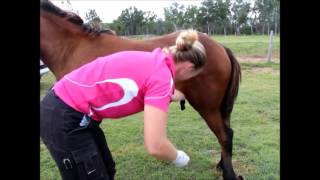
Equine physiotherapist, Caroline Lindsay (HorseSaddleRider.com), currently preparing a textbook on the topic of horse, saddle and rider asymmetry - evaluation and resolution, demonstrates the important subject of how to address scar tissue in this short video. This is a collection of bridle, stifle and castration scar manipulations demonstrated on her therapy courses to professional practitioners. Subscribe to see more films in this series as they appear.
**These techniques should not be attempted without first consulting the horse's vet for advice**
**It is not safe to treat non compliant horses**
Typically considered as merely cosmetic, scar tissue is the body’s hasty repair of an injury site. The body’s immediate response is to close off the injury site to pathogen invasion. Restoration of sensation acuity is not a priority thus paraesthesia can readily develop. Adhesions can develop which distort the original compartmentalisation of functional structures and nerve tissue can lose its insulation, distorting nerve signals. In short, sensory data collection and response can be absent as a result or, if present, scrambled to varying degrees of discomfort and compensation.
Many injury sites can remain active long after the site has been closed off, leaving residual trauma of a neuropathological character when nerve damage is present. The site can be hypersensitive to palpation as nerve tissue may repair with dissimilar resultant sensations than were present in the original uninjured site. Scar tissue can evoke memories of the original trauma because of the association that can be made with the damage and the sensations emanating from the injury site.
Adhesions are frequently poorly supplied with circulating blood to the extent that the scar can be ischaemic and deprived of nutrition to the tissue. Castrations are thus strongly indicated for rehabilitation.
Although there may be variation among veterinarian technique for castration, typically, the spermatic cord is protracted, severed and securely tied off to reduce risk of abdominal adhesions from any leaking fluid when the testes are removed. The wound does not necessitate stitching. Some recoil of the spermatic cord back into the groin can be anticipated and these can be addressed with gentle stretching of the scar which connects to the groin via fascia.
Похожие видео
Мой аккаунт