

Monday, 10 August, 2026г.
















Где искать: по сайтам Запорожской области, статьи, видео ролики
пример: покупка автомобиля в Запорожье
J. S. BACH - BRANDENBURG CONCERTO No. 4 - COLLEGIUM AUREUM
 У вашего броузера проблема в совместимости с HTML5
Brandenburg Concerto No. 4 in G major, BWV 1049 (1718 - 1721)
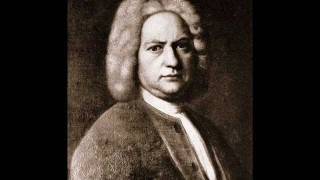
Johann Sebastian Bach (1685 - 1750)
(00:01) 1. Allegro
(07:24) 2. Andante
(11:13) 3. Presto
Hans-Martin Linde (1930-) & Günter Höller (1937-2016), Blockflöten
Franzjosef Maier (1925-2014), Violin
Gustav Leonhardt (1928-2012), Harpsichord
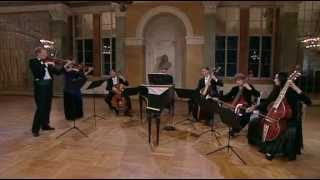
Collegium Aureum
Recording: 1965-1967, cedar hall, Fugger castle, Kirchheim in Schwaben
The Brandenburg Concertos by Johann Sebastian Bach (BWV 1046–1051, original title: Six Concerts à plusieurs instruments, are a collection of six instrumental works presented by Bach to Christian Ludwig, Margrave of Brandenburg-Schwedt, in 1721 (though probably composed earlier). They are widely regarded as some of the best orchestral compositions of the Baroque era.
Bach's dedication to the Margrave was dated 24 March 1721. Translated from the original French, the first sentence of Bach's dedication reads:
"As I had the good fortune a few years ago to be heard by Your Royal Highness, at Your Highness's commands, and as I noticed then that Your Highness took some pleasure in the little talents which Heaven has given me for Music, and as in taking Leave of Your Royal Highness, Your Highness deigned to honour me with the command to send Your Highness some pieces of my Composition: I have in accordance with Your Highness's most gracious orders taken the liberty of rendering my most humble duty to Your Royal Highness with the present Concertos, which I have adapted to several instruments; begging Your Highness most humbly not to judge their imperfection with the rigor of that discriminating and sensitive taste, which everyone knows Him to have for musical works, but rather to take into benign Consideration the profound respect and the most humble obedience which I thus attempt to show Him."
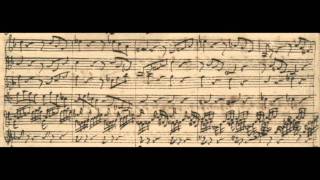
Because King Frederick William I of Prussia was not a significant patron of the arts, Christian Ludwig seems to have lacked the musicians in his Berlin ensemble to perform the concertos. The full score was left unused in the Margrave's library until his death in 1734, when it was sold for 24 groschen (as of 2014, about US$24) of silver. The autograph manuscript of the concertos was only rediscovered in the archives of Brandenburg by Siegfried Wilhelm Dehn in 1849; the concertos were first published in the following year.
The manuscript was nearly lost in World War II, when being transported for safekeeping to Prussia by train in the care of a librarian. The train came under aerial bombardment, and the librarian escaped from the train to the nearby forest, with the scores hidden under his coat.
No. 4 in G major, BWV 1049
Title on autograph score: Concerto 4to à Violino Principale, due Fiauti d'Echo, due Violini, una Viola è Violone in Ripieno, Violoncello è Continuo.
Concertino: violin and two recorders (described in the original score as "fiauti d'echo").
Ripieno: two violins, viola, violone, cello and basso continuo (harpsichord and/or viola da gamba)
The violin part in this concerto is extremely virtuosic in the first and third movements. In the second movement, the violin provides a bass when the concertino group plays unaccompanied.
It has been debated what instrument Bach had in mind for the "fiauti d'echo" parts. Nowadays these are usually played on alto recorders, although traverse flutes are sometimes used instead: it is also theorized Bach's original intent may have been the flageolet. In some performances, such as those conducted by Nikolaus Harnoncourt, the two recorders are positioned offstage, thus giving an "echo" effect.
Bach adapted the 4th Brandenburg concerto as a harpsichord concerto, BWV 1057.
Wikipedia
Теги:
J. S. Bach Johann Sebastian Bach Brandenburg Concerto No. 4 Baroque Music Collegium Aureum Concerto
Похожие видео

Мой аккаунт