

Sunday, 05 July, 2026г.
















Где искать: по сайтам Запорожской области, статьи, видео ролики
пример: покупка автомобиля в Запорожье
Jagdtiger Vs. IS-3-Which was Better? (Videos)
 У вашего броузера проблема в совместимости с HTML5
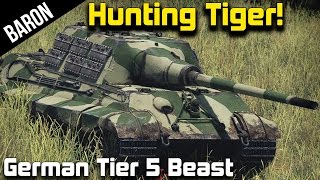
Jagdtiger ("Hunting Tiger") is the common name of a German heavy tank destroyer of World War II. The official German designation was Panzerjäger Tiger Ausf. B as it was based on a lengthened Tiger II chassis. The ordnance inventory designation was Sd. Kfz. 186. The 71-tonne Jagdtiger was the heaviest armored fighting vehicle used operationally during World War II and is the heaviest armored vehicle of any type to achieve series production. The vehicle carried a 128 mm PaK 44 L/55 main gun, capable of out-ranging and defeating any fielded Allied tank. It saw service in small numbers from late 1944 to the end of the war on both the Western and Eastern Front. Tiger ace Otto Carius commanded a company of Jagdtigers. His post-war memoir provides a rare combat history of the Jagdtigers that were under his command. Although 150 were ordered, only between 77 and 88 were produced. Due to an excessive weight, the Jagdtiger was continuously plagued with mechanical problems. Today, three Jagdtigers survive in museums.
There are two tanks known as IS-3. IS-3 (Objekt 244) was an IS-2 rearmed with the long-barrelled 85mm cannon (D-5T-85-BM). It was developed by LKZ (in Leningrad) and was not taken in service. IS-3 (Object 703) was developed in late 1944 by ChTZ (in Chelyabinsk) and left the factory shop in May 1945.[21] This tank had an improved armour layout, and a semi-hemispherical cast turret (resembling an overturned soup bowl) which became the hallmark of post-war Soviet tanks. While this low, hemispherical turret improved protection, it also significantly diminished the working headroom, especially for the loader (Soviet tanks in general are characterized by uncomfortably small interior space compared to Western tanks; however, this was addressed by Soviet recruitment criteria, which classified recruits' eligibility by numerous parameters, and specified that only very short men be drafted to serve in tank crews). The low turret also limited the maximum depression of the main gun, since the gun breech had little room inside the turret to pivot on its vertical axis. As a result, the IS-3 was less able to take advantage of hull-down positions than Western tanks.[22] The IS-3's pointed prow earned it the nickname Shchuka (Pike) by its crews. It weighed slightly less and stood 30 centimetres (12 in) lower than previous versions. Wartime production resulted in many mechanical problems and a hull weldline that had a tendency to crack open.[23]
The first public demonstration of the IS-3 came on 7 September 1945 during the Allied victory parade on Charlottenburgerstrasse in Berlin with the heavily reinforced 71st Guards Heavy Tank Regiment of the 2nd Guards Tank Army.[21] The IS-3 came too late to see action in World War II.
Starting in 1960, the IS-3 was slightly modernized as the IS-3M, in a manner similar to the IS-2M.
Теги:
warthunder war thunder war thunder tanks world of tanks baron baronvongmez war thunder destroyer jagdtiger is-3 is3 königstiger is2 is-2 soviet union nazi germany nazi gamezine mrbaliandras panzerjäger panzerjager hunting tiger which is better better war thunder tank destroyer ground force gameplay ground force gameplay war thunder gameplay ww2 ww 2 wwii world war 2 armored fighting vehicle World War II 128 mm PaK 44 L/55 stug 3 marder 3 heavy tank
Похожие видео
Мой аккаунт