
Tuesday, 11 August, 2026г.
Где искать: по сайтам Запорожской области, статьи, видео ролики
пример: покупка автомобиля в Запорожье
MACEDONIA: BORDER CROSSINGS WITH KOSOVO CLOSED
 У вашего броузера проблема в совместимости с HTML5
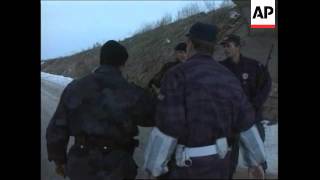
Albanian/Nat Crossing points along the Macedonia-Kosovo border remained deserted on Friday, three days after authorities closed the frontier to halt the flow of refugees. Aid officials says they fear hundreds of ethnic Albanians have turned to heavily-mined routes through the mountains lining the border. Aid organisations are working quickly to expand the border refugee camp in anticipation of those refugees who make it across the border. Three days ago, the Blace border crossing was awash with a sea of refugees fleeing a fresh round of ethnic cleansing in Kosovo. On Friday it lay still, closed to the estimated thousands left stranded in Kosovo. Macedonian authorities choked off the flow on Wednesday, blaming Western nations for failing to help shoulder the burden of more than a quarter of a million Kosovar refugees. Only handful of people with Macedonian passports were allowed across the border on Friday. Some of those who crossed estimated that 10-thousand people or more remained behind, clogged in the Kosovan border village of Djeneral Jankovic. Such is their desperation to escape, some refugees have resorted to picking their way through heavily-mined mountains to cross into Macedonia. The Macedonian government says more than 350 people have trekked across the wilderness from Kosovo. At least three were killed after triggering land mines. Aid organisations are now working to expand the main Blace refugee camp in anticipation of a fresh influx - by official or unofficial means. They plan to use the camp as a transit area from which refugees can be relocated elsewhere, taking the pressure off the border. SOUNDBITE: (German) "We are expecting high numbers of refugees to come here and therefore the capacity is being increased here to created a buffer area so that refugees from this camp can be moved to other camps." SUPER CAPTION: Aid worker, Swiss Disaster Relief The Macedonian authorities have sent out conflicting accounts of their policy towards the refugees. The U-N refugee agency in Geneva said Friday they had been assured the refugees would be able to cross the border. But Macedonia had earlier said it would enforce a new one-for-one policy - allowing in only the same number of refugees as the number taken out of the country. Later officials said the border was open to everyone, but claimed Serb forces were holding back the refugees. The U-N-H-C-R estimated there are 230-thousand- 900 refugees in Macedonia - about one-tenth of the country's normal population. Macedonia's leaders fear the refugee influx could alter the balance between the majority Slavs and ethnic Albanians, who made up about a third of the population before the conflict. Serious controversy could threaten the power-sharing government and lead to a potential political crisis in a nation hosting more than 15-thousand NATO soldiers. You can license this story through AP Archive: http://www.aparchive.com/metadata/youtube/9f771f042da700c392e8fef741137b8c Find out more about AP Archive: http://www.aparchive.com/HowWeWork
Теги:
AP Archive 124687 9f771f042da700c392e8fef741137b8c MACEDONIA: BORDER CROSSINGS WITH KOSOVO CLOSED Macedonia Kosovo Eastern Europe General news Social affairs
Похожие видео
Мой аккаунт