

Wednesday, 26 August, 2026г.















Где искать: по сайтам Запорожской области, статьи, видео ролики
пример: покупка автомобиля в Запорожье
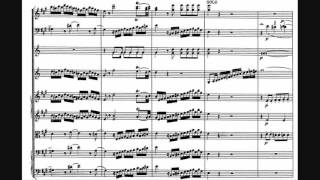
Mozart - Basset Horn Concerto in G major (fragment), (K. 584b / 621b)
 У вашего броузера проблема в совместимости с HTML5
Fragment of Bassetthorn Concerto in G K584b/621b
This fragment of 199 measures, essentially identical with the 1st movement of the Clarinet Concerto in A-major K622, was first catalogued in K3 under the number K584b. [It had been mentioned in K1 and K2 under the Clarinet Concerto K622, but not given its own number.] The draft full score covers 24 sides of 12-lined paper. The orchestral instruments are listed by Mozart as Violins, Violas, 2 Flutes, 2 Horns, and Bass--thus it lacks the Bassoons of the Clarinet Concerto K622. The solo part is written out completely, with some 1st Violin material and some Bass line, and occasionally middle parts that no doubt were ideas for the later completion. Measures 1-179 appear to have been written in one stroke. Then at measure 180 Mozart switches to a somewhat sharper pen with darker ink, and changes the accompaniment to a tone higher. It is clear at this stage Mozart had changed his mind and the composition was to be in A-major. Why this change? Colin Lawson explains in his Cambridge Music Handbook on the Clarinet Concerto that the Bassetthorn in G achieved more popularity in the 18th Century than extant repertoire might suggest, so Mozart's writing for a Bassetthorn in G would not be that unordinary, and he surely would have had discussions with Anton Stadler on this. It would seem Stadler had fitted a chromatic extension to his Bassetthorn in G, or at least the idea was in his mind. Apparently by the time Mozart finished 179 measures (what ever the time frame--see below) a different instrument was envisioned by Stadler. Ulrich Conrad tells us because of the key changing Mozart could not simply continue the old draft full score, but the recorded orchestral parts had to be transposed a tone higher--certainly a bothersome, but unavoidable paper work.
As early as Otto Jahn it was thought this fragment was composed "much earlier" than the Clarinet Concerto in A. Einstein believed the fragment originated from the end of 1789. Einstein felt Mozart left the composition in this fragmentary state until he completed the Concerto for Stadler two years later.
K6 moved the fragment to K621b, immediately in front of the Clarinet Concerto; believing Mozart would not let a fragmentary piece sit that long.
But Alan Tyson in a talk given in 1983 (and published in his 1987 Studies of the Autograph Scores) believed the fragment K621b was probably written down a year or two earlier. In his NMA-Watermarks volume commentary Tyson give the paper type #55 (sheets 1-6) as being used by Mozart in 1787 and most likely not later than 1788--although it was used for the Dances K609 in early 1791; and the paper type #82 (sheets 7-12) in the years 1785-1787, but also once in the composition of the Zauberflöte in 1791. But in a little known correspondence with Colin Lawson in 1995, Tyson stated he now favored the 1791 dating for the fragment K621b. Lawson believes a dating as early as 1787 is theoretically possible, but less likely on stylistic grounds. However he leaves the door open by stating the change at bar 180, together with the simultaneous change of quell, could be indicative of such a passage of time.
An interesting idea for the origin of K584b/621b comes from Hideo Noguchi. He believes, as does everyone else, the fragment was intended for Anton Stadler, but brings up the possibility it could have been written at the same time as K437--as both pieces are written for a Basetthorn in G. Noguchi believes perhaps the concert that would have premiered this Bassetthorn Concerto was cancelled for some reason, so Mozart stopped composing at measure 179.
Noguchi does not go further, but I will. K437, on a Metastasio text, is written for 2 Sopranos and Bass singer with an accompaniment of 2 Clarinets and Bassetthorn. It is thought to have been composed around 1787, presumably for domestic use in his friends--the Jacquin family--home. It is also presumed the Stadler brothers, Anton and Johann, participated in these doings at the Jacquin home. Mozart of course composed other pieces for members of the Jacquin family. In an article in the Fall 1997 "Performance Practice Review" Robert Adelson states the Bassetthorn in G could not possibly project over a large ensemble. Neal Zaslaw and Dexter Edge have studied Viennese concert sizes and conclude the orchestral accompaniment of Concertos "may often have been quite small, sometimes consisting of just one string player on a part". Mozart's Clarinet Concerto has the lightest scoring for winds of all his Concertos, and in the original K584b/621b version even lacks Bassoons. Would this not be a perfect candidate for a Concerto at a house concert at the Jacquins?
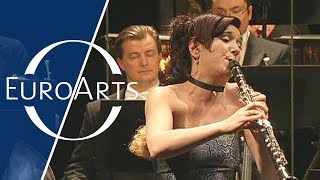
Basset Horn played by Gilles Thome
Теги:
mozart basett horn clarinet 622 621b stadler fragment magic flute don giovanni symphony jupiter eine kleine nachtmusik 525 492 alla turca clarinet concerto elvira madigan cosi fan tutte requiem linz prague haffner dissonant hunting
Похожие видео


Мой аккаунт