

Monday, 17 August, 2026г.
















Где искать: по сайтам Запорожской области, статьи, видео ролики
пример: покупка автомобиля в Запорожье
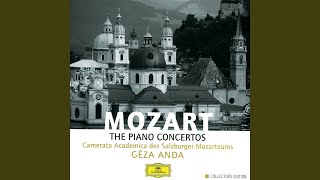
Mozart / Piano Concerto No. 16 in D major, K. 451 (Anda)
 У вашего броузера проблема в совместимости с HTML5
Wolfgang Amadeus Mozart (1756-1791)
Piano Concerto No. 16 in D major, K. 451 (1784)
00:00 - Allegro (Cadenza: Mozart)
09:41 - (Andante)
15:52 - Allegro di molto (Cadenza: Mozart)
Géza Anda (Piano & Conductor) and Camerata Academica des Salzburgers Mozarteums perform (1963)
"Immediately after the concerto [No. 14 in E-flat, K. 449] for Fräulein Ployer, he composed two more, in B-flat (K. 450) and in D (K. 451), and then, after the Piano Quintet (K. 452), still another, in G major (K. 453), a miracle of productivity in no way less extraordinary than the miracle of the three symphonies of 1788. For all these works are as different from one another as can be imagined. In an illuminating passage in a letter to his father, dated 26 May 1784, Mozart expressed himself briefly about them. He mentioned the two concertos in B-flat and D, and continued: 'I really cannot choose between the two of them, but I regard them both as concertos that are bound to make the performer sweat. From the point of view of difficulty the B♭ concerto beats the one in D. Well, I am very curious to hear which of the three, in B♭, D, and G, you and my sister prefer. The one in Eb does not belong at all to the same category. It is one of a quite peculiar kind, composed rather for a small orchestra than for a large one.' ...
"In the next two works [after the Piano Concerto No. 14], which are twins, in B-flat (K. 450) and D (K. 451), Mozart returns to more familiar paths. He uses a large orchestra, including in K. 451 trumpets and timpani, and in the Finale of K. 450, for the first time in a finale, the flute. The winds are essential, both as soloists and as a body. The orchestra is treated symphonically, with dialogue among its own members, and this leads naturally to a more brilliant treatment of the piano part. One hardly knows whether to call these works, particularly the second, piano concertos with obbligato orchestra or symphonies with obbligato piano solo. Both works are in the highest degree brilliant and personal. Mozart wishes to conquer his public, but without sacrificing anything of his own individuality. ...
"The D major Concerto seems like nothing more than a heroic and exuberant quick-march, with a song-like Andante, and a Rondo à la Joseph Haydn. Everything seems familiar and popular; yet at every instant there are surprises, an exuberance of spirit and a feeling of power, and unexpected refinements—like the piano passage in the recapitulation of the triumphal and yet passionate first movement, or the contrapuntal climax at the end of the second, or the very serious development section in the Rondo. The nineteenth century gradually lost any understanding for such things, since it had lost the feeling for any definite framework, or any given forms. But Mozart's public included some listeners who could appreciate every subtle divergence from the expected. That is the special quality of these Concertos—the fact that, in Mozart's own phrase, they are 'written for all kinds of ears, not just for the long ones.' Incidentally we may observe that few listeners had better musical ears than Mozart's sister Marianne. She pointed out a passage in the Andante in the D major Concerto that was too bare, and Mozart agreed with her and promised in a letter of 9-12 June 1784 to send her an ornamented variant. This variant survives, and is evidence that Mozart did not always play the solo part in the form in which it has come down to us." - Alfred Einstein
Painting: Powrót z balu, Józef Chełmoński
Теги:
Andante Allegro Allegro di molto Wolfgang Amadeus Mozart Piano Piano Concerto No. 16 D major K. 451 Classical Music Géza Anda
Похожие видео

Мой аккаунт