

Monday, 24 August, 2026г.












Где искать: по сайтам Запорожской области, статьи, видео ролики
пример: покупка автомобиля в Запорожье
Muslims celebrate Eid holiday in Kosovo, Kenya, Turkey and Nigeria
 У вашего броузера проблема в совместимости с HTML5
Millions of Muslims around the world are observing Eid al-Adha, or the 'Festival of Sacrifice', on Tuesday, one of Islam's most poignant religious holidays.
The holiday marks what Muslims believe is Ibrahim's willingness to sacrifice his own son as an act of obedience to God.
At the last minute, they believe, God intervened, and gave Ibrahim a ram to sacrifice instead.
In Turkey, tens of thousands of Syrians taking shelter at the Kilis refugee camp woke at dawn to take part in the traditional morning Eid prayers.
In Kilis town proper, goats, lambs and rams were prepped for sacrifice in an event organised by Turkey's Ministry of Religious Affairs.
Traditionally, Muslims sacrifice an animal at Eid and share the meat with their families, neighbours, and people less fortunate than themselves.
Syrian refugee families were also among those fed this year.
"Kilis is important for us because there are about 80,000 Syrians who were forced to leave Syria who now live here. And in an effort to assuage their pain, even if only for a while, we spend the holidays among them," said Halil Aktas from the Ministry of Religious Affairs.
He said 420 animals were sacrificed this year and they hoped to feed around 700 families from the meat.
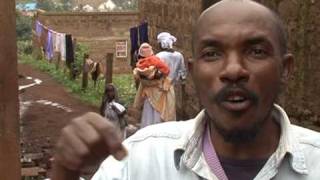
In East Africa, hundreds of Kenyan Muslims gathered for early morning prayers in Nairobi.
Community leader Imam Mohammed Salim spoke at the gathering on the importance of unity between both Muslims and non-Muslims.
After the recent attack on Nairobi's Westgate mall by al-Qaida-linked militant group al-Shabab, that saw more than 60 people killed and over 100 injured, peaceful relations between the Muslim and Christian communities in Kenya looked strained.
However, Muslim worshippers are still condemning the attack and are thankful to Kenyans, Muslims and non-Muslims, for maintaining peace and coming together to help one another in the nations hour of need.
"Let me thanks all the Kenyans, Muslims and non-Muslims, specifically non-Muslims, because it is as if it was implanted, or it was planned, so that there will be disunity between the Muslims and the non-Muslims, but that I find that on the contrary, people have come together, the Muslims and the non-Muslims," the imam said.
In other parts of the city, goats were seen hanging from hooks as they were slaughtered and skinned in preparation for the festival.
"Today is Eid and that is why I am slaughtering this goat. We are celebrating," said Abdi Mohammed, as he butchered a goat.
In West Africa, Nigerian Muslims in Lagos gathered at the Central Mosque for prayers.
Local chief Rabiu Danjuma said they were praying that God expose the country's enemies so it can again become "great".
In Kosovo, in the western town of Prizren, where Islamic tradition is strictly observed, Hezer Haliti and his family sacrificed a ram in observance of the holiday.
Aided by his brother, Veli, Hezer covered the ram's face with a cloth and then sacrificed the animal.
The slaughter was performed in front of his young son, Daris, and nephew Omar.
Veli Haliti said the practice is passed on from generation to generation.
"It's a Muslim tradition. We've learned it from our father. For over two decades in this house the same butcher has performed the same ceremony and slaughters a sacrificial ram," Haliti said.
Elsewhere in the city, celebrants gathered at the Mehmed Pasha Mosque for prayers in the courtyard.
Many then go to graveyards where they pray over the graves of their families and friends.
Kosovo is considered secular although the overwhelming majority of its population of 1.8 million are Muslims.
You can license this story through AP Archive: http://www.aparchive.com/metadata/youtube/48b9807da67cc4dbbfc13aea63b1c766
Find out more about AP Archive: http://www.aparchive.com/HowWeWork
Теги:
AP Archive 913868 48b9807da67cc4dbbfc13aea63b1c766 World Eid 3 Syria Kenya Kosovo Nigeria Nairobi Lagos Middle East East Africa Eastern Europe West Africa Social affairs General news Lifestyle
Похожие видео



Мой аккаунт