

Saturday, 25 July, 2026г.









Где искать: по сайтам Запорожской области, статьи, видео ролики
пример: покупка автомобиля в Запорожье
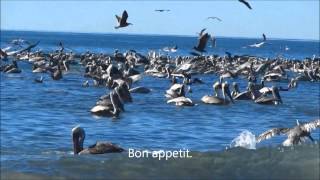
Pelicanos Blancos 2013, by trucha1618xx
 У вашего броузера проблема в совместимости с HTML5
Aves de México
2013/05/01 Pelícanos Blancos, Pelecanus erythrorhynchos, filmados en el Parque Ecológico de Xochimilco el 28 de abril y el 01 de mayo de 2013.
El pelícano blanco americano (Pelecanus erythrorhynchos) es una especie de ave de la familia de los pelícanos (Pelecanidae). Es muy grande (1.2-1.8 m), con manchas negras en las alas y un pico anaranjado muy grande y ancho. Su envergadura es de aproximadamente 3 m. Son muy gráciles en vuelo, moviendo sus alas en lentos y poderosos golpes.
Practica la pesca cooperativa; cada ave come algo de 1,5 kg de peces por día, mayormente carpas Cyprinidae, Leuciscus cephalus, sardinas, percas, pez gato, Seriola zonata.
Anidan en colonias de varios centenares de casales en islas de lagos de agua dulce de Norteamérica. Las colonias de anidación más norteñas pueden enontrarse en islas, en los rápidos del río Slave entre Fort Fitzgerald (Alberta), y Fort Smith (Territorios del Noroeste). Cerca del 10-20% de la población usa la isla Gunnison en el Gran Lago Salado como territorio de anidación. Las hembras ovipositan 2 o 3 huevos en ligeras depresiones del suelo. Ambos progenitores incuban.
Invernan en California central y a lo largo de las costas del Pacífico de Guatemala; también en las playas del Golfo de México.
La caza furtiva es la causa más importante de mortalidad. Las colonias son sensibles a las molestias; y las visitas de humanos pueden causar que los pelícanos abandonen sus nidos.
The American White Pelican (Pelecanus erythrorhynchos) is a large aquatic bird from the order Pelecaniformes. It breeds in interior North America, moving south and to the coasts, as far as Central America and South America, in winter.
The American White Pelican rivals the Trumpeter Swan as the longest bird native to North America. Both very large and plump, it has an overall length is about 50--70 in (130--180 cm), courtesy of the huge beak which measures 11.3--15.2 in (290--390 mm) in males and 10.3--14.2 in (260--360 mm) in females. It has a wingspan of about 95--120 in (240--300 cm). The species also has the second largest average wingspan of any North American bird, after the California Condor. Body weight can range between 9.2 and 30 lb (4.2 and 14 kg),[4] although typically these birds average between 11 and 20 lb (5.0 and 9.1 kg). Among standard measurements, the wing chord measures 20--26.7 in (51--68 cm) and the tarsus measures 3.9--5.4 in (9.9--14 cm) long. The plumage is almost entirely bright white, except the black primary and secondary remiges, which are hardly visible except in flight. From early spring until after breeding has finished in mid-late summer, the breast feathers have a yellowish hue. After moulting into the eclipse plumage, the upper head often has a grey hue, as blackish feathers grow between the small wispy white crest. The bill is huge and flat on the top, with a large throat sac below, and, in the breeding season, is vivid orange in color as is the iris, the bare skin around the eye, and the feet. In the breeding season, there is a laterally flattened "horn" on the upper bill, located about one-third the bill's length behind the tip. Outside of the breeding season the bare parts become duller in color, with the naked facial skin yellow and the bill, pouch, and feet an orangy-flesh color.
Apart from the difference in size, males and females look exactly alike. Immature birds have light grey plumage with darker brownish nape and remiges. Their bare parts are dull grey. Chicks are naked at first, then grow white down feathers all over, before moulting to the immature plumage.
American White Pelicans nest in colonies of several hundred pairs on islands in remote brackish and freshwater lakes of inland North America. The most northerly nesting colony can be found on islands in the rapids of the Slave River between Fort Fitzgerald, Alberta and Fort Smith, Northwest Territories. About 10-20% of the population uses Gunnison Island in the Great Basin's Great Salt Lake as a nesting ground. The southernmost colonies are in southwestern Ontario and northeastern California. Nesting colonies exist as far south as Albany County in southern Wyoming. They winter on the Pacific and Gulf of Mexico coasts from central California and Florida south to Panama, and along the Mississippi River at least as far north as St. Louis, Missouri. In winter quarters, they are rarely found on the open seashore, preferring estuaries and lakes. They cross deserts and mountains but avoid the open ocean on migration.
http://es.wikipedia.org/wiki/Pelecanus_erythrorhynchos
http://en.wikipedia.org/wiki/American_White_Pelican
by trucha1618xx
Cámara: Canon VIXIA HF R32
Теги:
Pelicanos blancos white pelican Xochimilco pelecanus erythrorhynchos aves bird agua water lago laguna lake wetlands humedal trekking hiking outdoors wildlife pájaro ornitología ornitology ecología ecology naturaleza nature Wild Life (Pupil Album) Duck Birds Park Mountain Climbing Garden migración VIXIA HF R32 Canon National Mountains migration Ducks Aves de México
Похожие видео



Мой аккаунт