

Saturday, 06 June, 2026г.
















Где искать: по сайтам Запорожской области, статьи, видео ролики
пример: покупка автомобиля в Запорожье
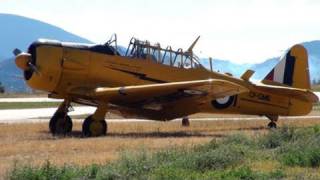
T 28 Flight
 У вашего броузера проблема в совместимости с HTML5
T-28 Take-Off
Engine: One1,425-hp Wright Cyclone R-1820-86 radial piston engine
Weight: Empty 6,424 lbs., Max Takeoff 8,500 lbs.
Wing Span: 40ft. 1in.
Length: 33ft. 0in.
Height: 12ft. 8in.
Performance:
Maximum Speed: 343 mph
Ceiling: 35,500 ft.
Range: 1,060 miles
History: When the United States Air Force set out to replace its aging T-6 Texan trainers, North American was hired to complete the task. What they presented was the Model NA-159 piston-engine trainer; a design that was so successful that it was responsible for gaining a contract for two XT-28 prototypes. After an evaluation of these prototypes and an initial flight on September 26, 1949, the Air Force was so impressed that it ordered production to begin on the newly designated T-28A.
The Trojan, as it became known, had a frameless canopy and a Wright R-1300 engine that, when combined, gave it a top speed that often exceeded 280 mph. First orders of 266 planes in 1950 eventually grew to 1,194. After it became evident that the Air Force had found a very successful design, the United Sates Navy and Marine Corps adopted it as well. Two years later, 489 standardized versions (T-28Bs) were ordered by the Navy, mainly differing from the T-28A in its use of the more-powerful Wright R-1820-86 engine. Following this, 299 T-28Cs were produced, which were fitted with an arrester gear for carrier-deck landing training.
In 1962, North American began supplying T-28Ds for the counter-insurgency role. Six underwing hard-points were added in order for the aircraft to accept a variety of weapons. The T-28 saw action in both Southeast Asia and North Africa. The attack trainer version of the T-28D was called the AT-28D. France's Sud-Aviation converted over 240 T-28Ds into Fennecs and used them as replacements for their Algerian-based T-6s. Fennecs performed admirably in the close-support, reconnaissance and patrol roles.
Теги:
flight
Похожие видео
Мой аккаунт