

Monday, 03 August, 2026г.
















Где искать: по сайтам Запорожской области, статьи, видео ролики
пример: покупка автомобиля в Запорожье
What’s happening to Betelgeuse?
 У вашего броузера проблема в совместимости с HTML5
Betelgeuse is usually the eleventh-brightest star in the night sky and, after Rigel, the second-brightest in the constellation of Orion.
It is a distinctly reddish semiregular variable star whose apparent magnitude, varying between +0.0 and +1.3, has the widest range displayed by any first-magnitude star.
Classified as a red supergiant of spectral type M1-2, Betelgeuse is one of the largest stars visible to the naked eye.
Imagined as being at the center of the Solar System, its surface would lie beyond the asteroid belt and it would engulf the orbits of Mercury, Venus, Earth, Mars, and possibly Jupiter.
Less than 10 million years old, Betelgeuse has evolved rapidly because of its large mass and is expected to end its evolution with a supernova explosion.
Having been ejected from its birthplace in the Orion OB1 Association, which includes the stars in Orion's Belt, this runaway star has been observed moving through the interstellar medium at a speed of 30 km/s.
Studies have reported an apparent size ranging from 0.042 to 0.056 arcseconds; that range of determinations is ascribed to non-sphericity, limb darkening, pulsations and varying appearance at different wavelengths.
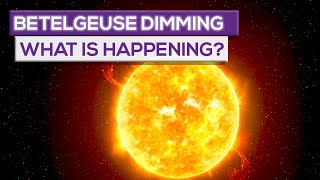
Starting in October 2019, the luminosity of Betelgeuse began to dim noticeably.
By January 2020 the brightness of this supergiant had dropped by a factor of approximately 2.5 from magnitude 0.5 to 1.5. Astronometric images have shown it may no longer be round.
Despite speculation that the dimming might indicate it could go supernova, astrophysicists believe such an event is not imminent, but it will happen most likely within 100,000 years.
#betelgeuse #star #supernova #adrianosastre
Теги:
star giant supernova adrianosastre brighest sky night orion constellation variable magnitude first naked eye visible earth light years explosion dim dimming 2020 2019 luminosity moon astrophysicists imminent event fenomeno dramatic show celestial astronomers life intense betelgeuse
Похожие видео

Мой аккаунт