














Где искать: по сайтам Запорожской области, статьи, видео ролики
пример: покупка автомобиля в Запорожье
Belarus: WHO meets authorities in plan to improve stranded migrants' health conditions
 У вашего броузера проблема в совместимости с HTML5
Follow us on Telegram:
https://t.me/s/ruptlynews
The World Health Organization’s regional director for Europe Hans Kluge visited the transport and logistics centre accommodating migrants near the Bruzgi checkpoint on the Belarusian-Polish border on Monday.
During the visit, Kluge met with Belarusian Health Minister Dzmitry Pinevich and Grodno Region Governor Uladzimir Karanik and discussed a joint plan “to improve the health conditions” in migrants’ temporary accommodation centre.
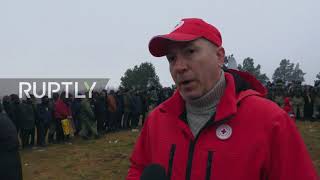
Dmitry Shevtsov, Belarusian Red Cross Secretary General, reported that the organisation has a sufficient stock of humanitarian aid available to distribute.
“Every week we receive [aid] from our public organisations, from enterprises from all over the republic, both dairy products and canned goods, and other things. We have the necessary stock of food, blankets, sleeping bags and clothes,” said Shevtsov.
Shevtsov also noted that some migrants caught colds due to prolonged stay in the tent camp and nights on the cold ground, as well as some migrants suffering from chronic illnesses.
“We redirect [them] to the ambulance. If the ambulance cannot solve the issue, to give some medication, because it is not the competence of the ambulance, then we contact the health department and they actually give these medications to these people the next day,” he stressed.
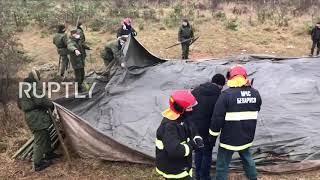
The migrants continue to stay at the temporary accommodation centres, where they are currently receiving hot meals from a field kitchen, water, sleeping quarters and medicines.
Last week saw the departure of the first repatriation flight from Minsk to Baghdad via Erbil, with hundreds onboard, as the crisis enters its third week.
The migration situation on the Belarusian-Polish border escalated at the beginning of November. sSeveral thousand refugees from the Middle East and Africa came to Belarus in an attempt to reach Poland and the European Union, an attempt blocked by the Polish authorities.
SOUNDBITES:
SOT, Hans Kluge, World Health Organisation regional director for Europe: “My team was here only yesterday, very [INAUDIBLE] team of experts. We visited a warehouse here. Then we were going to go to the hospitals, where, I understand, migrants are being taken care of. And then we have a sit down with the minister of Health, Dr. [Dmitry] Pinevich, with Governor of Grodno region Mr. [Vladimir] Karanik, to plan how we can work together to improve the health conditions.”
SOT, Dmitry Shevtsov, Belarusian Red Cross secretary general (Russian): “People are not threatened here because they are in a heated room where the temperature is constantly maintained at 16-18 degrees Celsius. As for humanitarian aid, we have enough of it. During all this time, we have distributed 53.6 tons of food, as well as water and milk. In addition, every week we receive [aid] from our public organisations, from enterprises from all over the republic, both dairy products and canned goods, and other things. We have enough [humanitarian aid]. In the very beginning the Ministry for Emergency Situations allocated us one room in order to be able to store [humanitarian aid]. At the moment, they give us three to four large rooms, depending on the number of people who want to provide humanitarian assistance. Yes, that is actually true. We have the necessary stock of food, blankets, sleeping bags and clothes.”
SOT, Dmitry Shevtsov, Belarusian Red Cross secretary general (Russian): “The most important thing is colds. We hear that people are coughing because being out in the woods on the cold ground for a long time has not gone well. People with chronic illnesses don’t come to us as much and we’ve been approached about what needs to be done. There was a woman with diabetes who was running out of medication and a man with a specific disease, and others as well. We redirect them to the ambulance. If the ambulance cannot solve the issue, to give some medication, because it is not the competence of the ambulance, then we contact the health department and they actually give these medications to these people the next day.”
SOT, Dmitry Shevtsov, Belarusian Red Cross secretary general (Russian): “It was clear that it took some time to make some considered decisions, to find a common ground to simplify this procedure, because many migrants say: ‘We are not going just to become refugees. We have families there, we want to unite.’ There is an international programme to unite families. But there was a situation when people were being poured with cold water in such cold weather. We saw the number of people and children, including those who were wet, not to mention the tear gas, needing help. I want to say as a doctor and as a human being, this is inhumane.”
#Belarus #migrants
Video ID: 20211122-010
Video on Demand: https://ruptly.tv/videos/20211122-010
Contact: [email protected]
Twitter: http://twitter.com/Ruptly
Facebook: http://www.facebook.com/Ruptly