












Где искать: по сайтам Запорожской области, статьи, видео ролики
пример: покупка автомобиля в Запорожье
Lebanon: Cancer patients rally in Beirut against drug interruptions in country
 У вашего броузера проблема в совместимости с HTML5
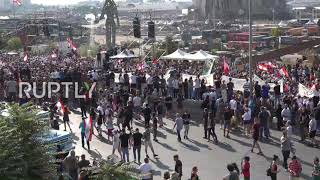
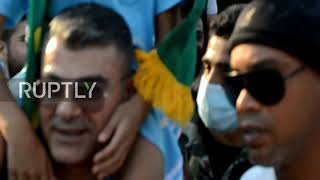
Scores of cancer-stricken patients and their families rallied in Gibran Khalil Gibran Park in front of the UN ESCWA building in Beirut on Thursday, to denounce therapeutic interruptions in Lebanon.
Lebanon is grappling multiple social and economic crises affecting all aspects of life including the health sector.
—-
SOT, Speaker (Arabic): “The government must secure it (the treatment), our government should not kill us (they should provide it even if they have to sell their palaces or properties. They are responsible for us (maintaining our needs) we should not pass away because of the medicines (interruptions and shortages).”
SOT, Protester (Arabic): “Every patient is suffering. As a Lebanese population, civil community, revolutionaries and Lebanese youth, we are not supposed to abandon them.”
SOT, Claudis Al- Asmar, mother of cancer patient (Arabic): “It (the drug) is not available, we keep looking for it in various places, but it is inaccessible. Your destiny is known in the case you do not take your medication.”
SOT, Claudis Al- Asmar, mother of cancer patient (Arabic): “There is no alternative (for the medicine). Even if you want to buy another drug, it is unreachable, as if they tell you to go ahead and die.”
SOT, Allan Abu Suliman, Cancer-stricken patient (Arabic): “Honestly, I cannot say it is just a suffering, because it is exceeding that. It is merely a humiliation in the incapability to secure the drug.”
SOT, Allan Abu Suliman, Cancer-stricken patient (Arabic): “During the first year, the drug was mostly accessible, but it became extremely hard to find in the second year.”
SOT, Allan Abu Suliman, Cancer-stricken patient (Arabic): “” haven’t had the treatment in a month, what next? Where are we heading? What is going to happen to me?”
SOT, Ritta, Cancer patient in cancer department at Al-Roum Hospital (Arabic): “Honestly, we are unable to find it (the drug easily), as we have to strive to find it in the pharmacies. Moreover, we could only buy it out of their sympathy, while many pharmacies that tell us that it is (the drug) inaccessible. We are obliged to move around many places, in case we find it we are very lucky, otherwise, I do not know how to maintain our treatment. They prefer us to die than to secure the drugs.”
SOT, Micheline Brmmana, Chief Nursing Officer at Oncology Department, Al-Roum Hospital (Arabic): “We are grappling with a shortage of patients’ medications. In many cases we provide partial treatment, when the patient comes for full treatment protocol, the doctor, out of drug shortages, is forced to adhere to incomplete protocol giving him some medicines only.”
SOT, Micheline Brmmana, Chief Nursing Officer at Oncology Department, Al-Roum Hospital (Arabic): “Occasionally, patients cancel their treatment and do not come to (hospital) because they are unable to maintain the drugs.”
SOT, Hani Nassar, Head of Barbara Nassar Association for Cancer Patient Support (Arabic): “The Bank of Lebanon (Central) states that the amount it provided to boost cancer drugs over the past year equals all the amount paid in the first six months of this year. Meanwhile, the drugs are being run out (in our markets) yet we find them in Turkey, Egypt, Jordan and Iraq, though the Lebanese people has the right to be treated by them. It is being bought and sold here to get benefits out of price difference as a single vial costs roughly $5,000.”
SOT, Hani Nassar, Head of Barbara Nassar Association for Cancer Patient Support (Arabic): “One intensive treatment drug box is extremely expensive, it costs up to $10.000 or $5000. it is impossible for the patient to maintain it from abroad, if it is missing inside Lebanon. Therefore, the purchasing power of the Lebanese citizen today could not afford him to buy the drugs.”
SOT, Hani Nassar, Head of Barbara Nassar Association for Cancer Patient Support (Arabic): “The cancer-stricken patient is unable to wait since he can manage to survive by taking it, otherwise he will die.”
#Lebanon #Beirut #CancerPatients
Video ID: 20210826-058
Video on Demand: https://ruptly.tv/videos/20210826-058
Contact: [email protected]
Twitter: http://twitter.com/Ruptly
Facebook: http://www.facebook.com/Ruptly